
Drywall Corner Bead Types: Metal, PVC and Paper-Faced (and Where Each Fails)
Ask three experienced crews which corner bead is best and you will get three defensible answers. That is not because the products are equally good at everything. It is because most comparisons skip the first question: are you fitting a rigid bead or a flexible tape? Answer that, and the material decision usually makes itself.
Start with the split most guides skip: bead or tape
Almost every article on this topic lists materials — metal, vinyl, paper-faced — and never mentions that the products come in two fundamentally different physical forms.
A rigid corner bead is a pre-formed profile. It holds its angle by itself, and it is attached mechanically: nailed, screwed, stapled or crimped through its flanges into the board and framing. A corner tape is a flat, roll-packed composite that is folded along its centreline and embedded in joint compound. There are no fasteners through it at all.
That difference in attachment drives almost everything that follows.
A mechanically fastened bead is held by fasteners that pass into framing. Framing moves — it dries, shrinks and shifts seasonally — and when it does, those fasteners can be pushed outward, taking a ring of compound with them. That is the mechanism behind two of the most common corner complaints: hairline cracks running along the bead flange, and nail or screw heads telegraphing through the finished surface.
A tape-on corner is bonded to the board face with compound instead. There is no fastener to be pushed out, which is precisely why paper-faced products are described as virtually eliminating corner cracks, edge chips and nail pops.
The rolled form has a second practical advantage: it is packed in rolls and cut to the length you actually need, which reduces offcuts and transport waste compared with handling rigid lengths. One supplier of rolled metal corner tape describes it as easier to use than traditional metal corner bead for exactly this reason. Rolled products are also, by their nature, usable on both inside and outside corners — you fold them the other way.
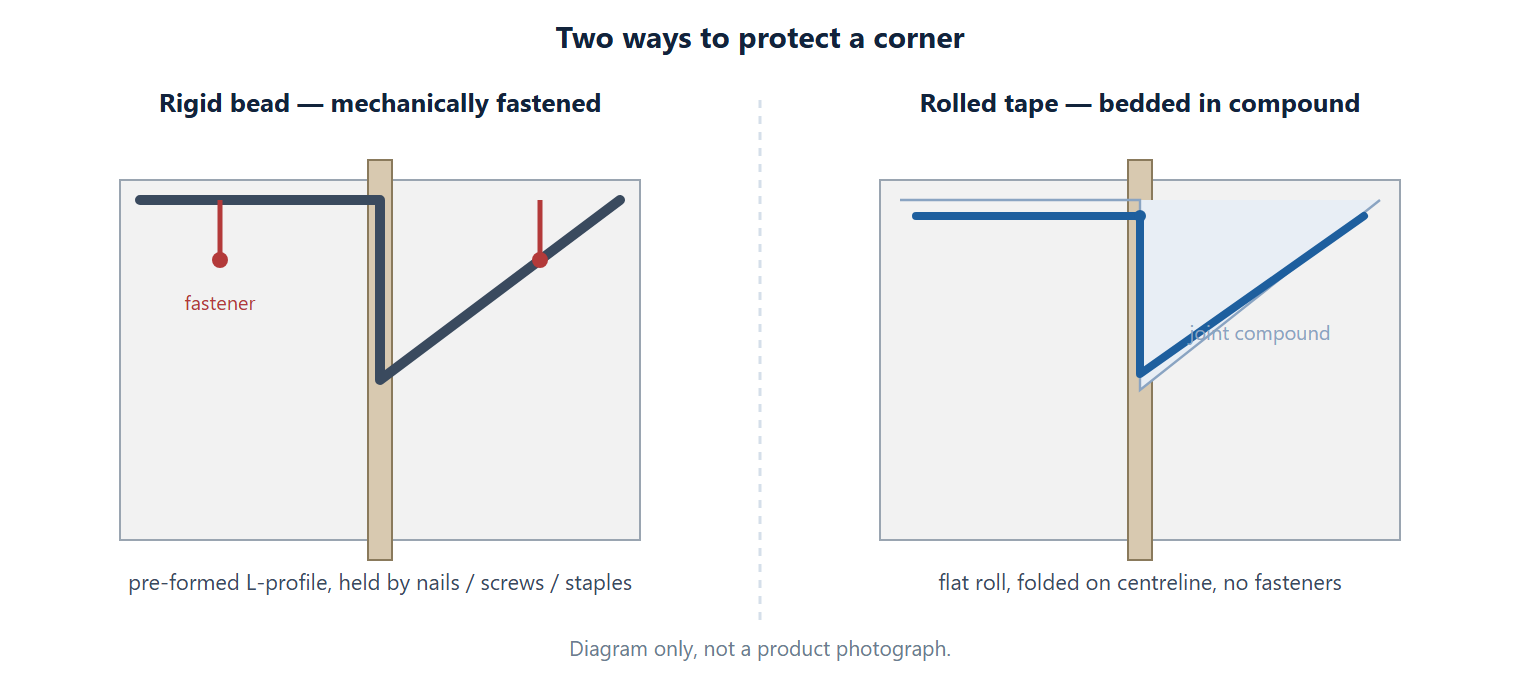
Two ways to protect a corner: a rigid profile fixed with fasteners, and a roll-packed tape embedded in compound. Diagram only, not a product photograph.Two ways to protect a corner: a rigid profile fixed with fasteners, and a roll-packed tape embedded in compound. Diagram only, not a product photograph.
So before comparing materials, decide which form your job suits: a rigid profile where you want maximum straightness and impact resistance and are happy to fasten, or a rolled tape where you want to cover inside and outside corners with one product and keep fasteners out of the finish.
The three material families at a glance
| Family | What it is | Where it earns its keep | How it tends to fail | Cost position |
|---|---|---|---|---|
| Metal | Reinforcing strips of galvanized steel or aluminium, combined with a facing layer | Outside corners that must stay straight and take knocks; high-traffic routes | Rust if the coating is breached and moisture persists; dents under hard impact; edge cracking and nail pops when fastened | Higher material cost; rolled form cuts waste because you cut only what you need |
| PVC | Extruded PVC profile, often with mesh wings for compound keying | Wet and humid areas; stucco, plaster and modified stucco systems; budget-driven volume work | Less impact-resistant than metal; can deform under sustained heat | Described as costing significantly less than metal or fiberglass beads |
| Paper-faced | Metal or rigid core bonded to a paper facing, embedded in compound | Inside corners and finish-critical rooms; anywhere you want to eliminate fasteners | Paper facing is the wrong choice where moisture is persistent; not the pick for heavy impact | Material cost is offset by lower compound consumption and one less finishing pass |
Metal corner reinforcement: when the line has to stay straight
Metal corner products combine metal reinforcing strips with a facing layer. Here you need to know one thing up front: the facing layer is available in more than one version. Own-brand documentation describes it both as paper and as fiberglass mesh, and both versions are sold. The facing is not cosmetic — it determines how the product keys into joint compound, how it feathers at the edges and how it behaves under sanding. Confirm which version you are being quoted before you order.
What metal buys you is straightness and impact resistance. The product literature credits it with high hardness and good shaping performance, straightening wall corners efficiently and preventing deformation, denting and collision damage. If the corner in question sits in a corridor, a stairwell, a garage or anywhere that carts, tools and furniture will find it, that is the property you are buying.
How it fails is equally specific. Metal corner products are described as being used on both internal and external corners, but the metal itself is only as durable as its coating: breach the zinc layer during cutting or installation, add persistent moisture, and rust will eventually bleed through the paint. Hard, concentrated impacts can dent a metal nose. And where the product is mechanically fastened, the fastener-related cracking and nail pops described above remain on the table.
The rolled form answers some of this: cut only the length you need, fold on the centreline, embed in compound, and do not overlap at the corner — overlapping ruins the flatness.
For rolled metal corner tape with specifications and packing details, see the metal corner tape product page.
PVC corner bead: when moisture rules out metal
PVC corner bead exists to remove rust from the equation entirely. It is rust-proof and moisture-resistant, and it is easy to cut and install. It is also positioned for stucco, plaster and modified stucco systems, not just drywall — a useful thing to know if your project spans both wall finishes.
The trade-off is impact. PVC is less rigid than steel, so a blow that would dent metal may instead deform or cut it, and the profile gives less support to the corner nose. Sustained heat is the other consideration: PVC is a thermoplastic, so it will soften and move where metal would not. That is a design question on sunlit atriums and around heat sources, and a code question on assemblies that require non-combustible components — neither of which this article can answer for your jurisdiction.
Where PVC wins is the combination of wet areas and budget. The same literature describes it as costing significantly less than metal or fiberglass beads while remaining rust-proof and moisture-resistant, and calls it the budget-smart choice for large-scale residential and commercial projects. On a job with hundreds of corners in bathrooms, basements and service areas, that arithmetic matters more than the impact rating of any single corner.
On fire-rated assemblies, do not assume. Whether a combustible trim accessory is permitted depends on the assembly design and the authority having jurisdiction, so treat it as a question for the project specification, not a material preference.
See the PVC corner bead product page for available profiles.
Paper-faced corner bead: when the finish comes first
Paper-faced corner bead bonds a high-strength metal core to a tough paper facing. Its defining feature is what it does without: no nails, no screws, no staples, no crimps. It goes into joint compound, and that is the whole fixing method.
Everything else follows from that. With no fastener driven into framing, there is no fastener to be pushed out when the framing dries and moves — which is the mechanism the product literature points to when it describes virtually eliminating corner cracks, edge chips and nail pops. It also reduces joint compound consumption and removes one pass of finishing, and it will not be damaged by sanding. For a crew, the saving is in labour and material, not just in the bead.
The finish argument is real but narrower than marketing usually suggests. Paper-faced bead is described as available in a number of different widths to suit most wallboard applications, which matters because the flange has to feather into the wall without leaving a ridge. What it does not do is make a corner impact-proof: the core is metal or rigid, but the whole assembly is still a thin composite bedded in compound, and it is not the right answer for a corner that will be hit.
Where to be careful: persistent moisture. A paper facing is the one material here that can absorb water, so in continuously wet positions PVC is the safer call.
See the paper-faced corner bead product page for widths and profiles.
The four paper-faced profiles — and inside corners, off-angles and raw ends
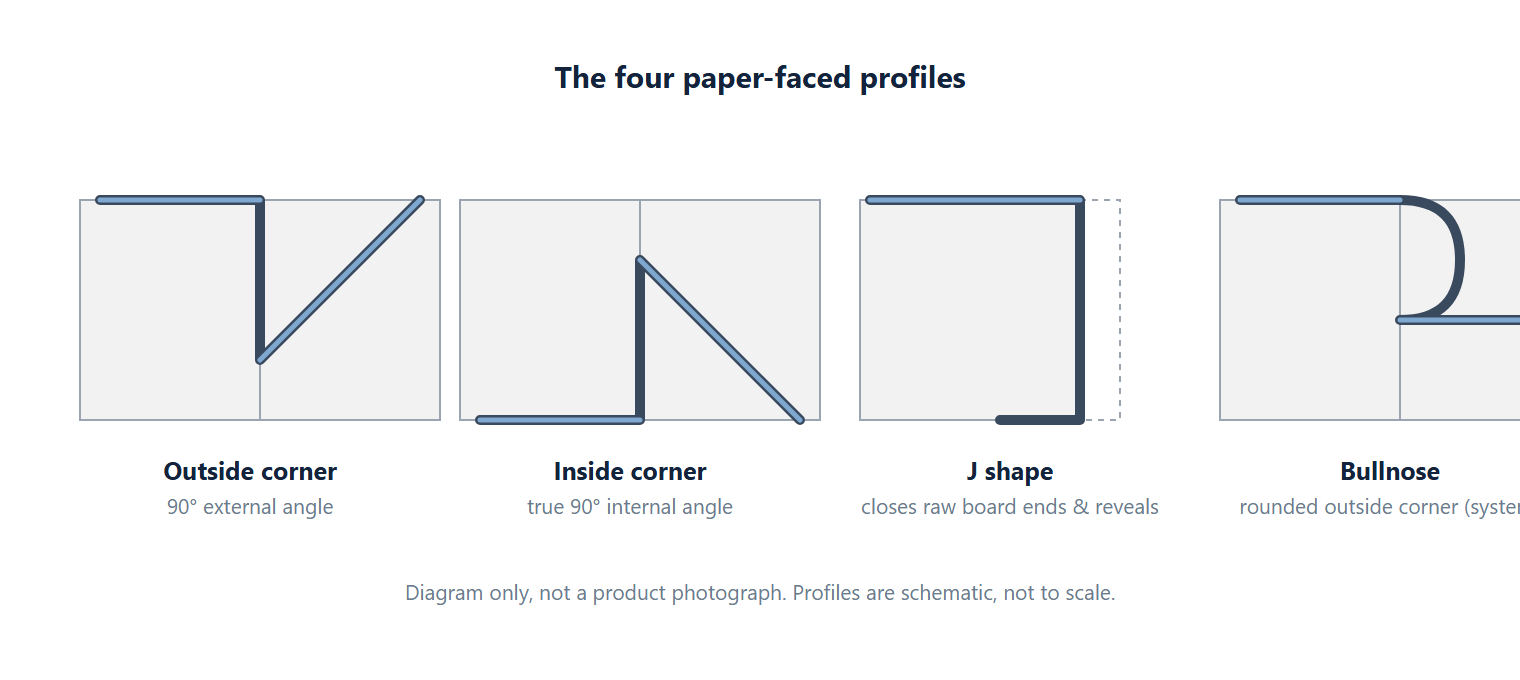
This is where most guides give up and say "bullnose is for rounded corners." The four profiles solve four different problems.
- 1.Outside corner bead is for 90° outside corners, and is described as suitable for use on any thickness of wallboard.
- 2.Inside corner bead is designed for the inside 90° structure, forming a true right angle, also on any thickness of wallboard.
- 3.J shape finishes off bi-fold closet doors, runs under all door and window encasements, and closes rough drywall ends. In other words, it is not a corner product at all — it is an edge-closing product, and it is the answer to "what finishes the raw edge where the board just stops."
- 4.Bullnose forms a smooth rounded outside corner and is easy to install.
Inside corners deserve more attention than they get. Most corner content only addresses outside corners, which is odd, because inside corners crack for the same reasons outside corners do. You have two reasonable routes: an inside-corner profile designed to hold a true 90°, or a rolled tape folded the other way, which handles inside and outside corners with the same product.
Off-angles are a different problem. Bay windows, splayed walls and anything that is not a true 90° need a profile that can bend or be folded off its centreline. A rolled tape is more forgiving here than a rigid profile, but how far off-angle a given product will hold is a question for the supplier, not a guess.
Bullnose is a system, not a strip. A rounded corner changes how the skirting and the door casing meet the wall, and where three planes meet — the top corner of a doorway, for instance — the radius has to be closed off with a matching transition piece rather than butted and filled. Decide the radius and the trim detail together, before the bead is on the wall.
What the symptom tells you
| Symptom | What it usually means | What to change at specification stage |
|---|---|---|
| Rust stains or yellow bleed along the corner | Coating breached, or persistent moisture reaching metal | Use PVC in wet areas; ensure metal is fully encapsulated in compound |
| Hairline crack running along the flange | Fastener or rigid profile moving with the framing | Move to a tape-on, fastener-free paper-faced solution |
| Fastener heads showing through the finish | Fasteners working loose as framing dries and shrinks | Same as above — remove the fastener from the equation |
| Corner nose dented or deformed | Impact beyond what the profile supports | Specify metal, or a profile with an impact-resistant nose |
| A straight line showing through paint in raking light | The bead edge has not been feathered out | Paper-faced profiles key into compound and feather more forgivingly |
| Rounded corner does not meet the skirting | Radius chosen without the trim detail | Confirm radius and transition pieces together, before ordering |
Note what is absent from that table: no prices, no service lives, no percentages. Those numbers circulate widely on supplier blogs and are rarely traceable to anything. What you can act on is the mechanism.
Where ASTM C1047 fits
If a specification calls up a standard for drywall trim accessories, it is almost always ASTM C1047, currently published as C1047-19, Standard Specification for Accessories for Gypsum Wallboard and Gypsum Veneer Base. It covers accessories used with gypsum wallboard and gypsum veneer base assemblies to protect edges and corners and to provide architectural features.
Two of its material requirements are worth knowing, because they tell you what to ask a supplier for:
- 1.Steel accessories — and the steel component of steel-and-paper accessories — are to be manufactured from zinc-coated cold-rolled sheet steel before any coating is applied.
- 2.The paper component of steel-and-paper accessories has to meet requirements for thickness, tensile strength, dimensional stability, and bond of joint tape to joint compound.
The standard also requires accessories to be free of twist or camber that would prevent their intended use, and free of burrs and sharp edges.
What it does not do is set prices, service lives or installation method, and it does not tell you which material to pick. It is a purchasing specification: it gives you something concrete to demand a certificate against. The exact clause values live in the standard itself, not in a summary — get the full text and the project specification side by side. ASTM C1047-19 at astm.org
What to confirm before you order
We are not going to give you numbers we cannot source. Here is what to ask for instead:
1.Which facing layer — paper or fiberglass mesh. Both are sold, and the facing drives compound keying and sanding behaviour.
2.Width, and radius if you are using bullnose, checked against the wallboard thickness and the skirting detail you intend to fit.
3.Metal specification and coating — substrate and zinc coating, with a material certificate rather than a claim.
4.Compatibility with the joint compound you actually use, including setting-type compounds if the schedule is tight.
5.Whether the project specification cites ASTM C1047 or requires non-combustible trim on any rated assembly.
6.Roll length and packing, if you are buying rolled tape — and how much you expect to lose to offcuts.
Common questions
Do inside corners need corner bead?
Yes, and they are specified more often than they should be. Inside corners crack for the same reasons outside corners do. Use either an inside-corner profile designed to hold a true 90° or a rolled tape folded the opposite way.
Can PVC corner bead be used in fire-rated assemblies?
Not as a default. Whether a combustible trim accessory is permitted depends on the assembly design and the authority having jurisdiction. Treat it as a specification question and get it in writing before the bead is on the wall.
Which resists cracking better, paper-faced or metal?
Paper-faced, for a specific reason: it is embedded in compound with no mechanical fasteners, so there is no fastener to be pushed out when framing moves. That addresses fastener-driven cracking. It does not make the corner more impact-resistant — if the corner will be hit, that is a separate decision.
Three families, two forms, and a failure mode for each. Pick the form first, then the material, then confirm the spec in writing.
See metal, PVC and paper-faced corner solutions in our catalog
Address
Head office Add: BLDG#26,MAX Technology Park Phase II,Baoshan District,Shanghai China
Factory Add: Shanghai Ruifiber (Fengxian) Industry Park, Fengxian, Xuzhou, China
Lgl_1100@vip.163.com
Ruifibersales2@ruifiber.com
Phone
0086-21-56659615(Sales dept)
0086-18621915640
0086-1561815 6160
Hours
Monday-Friday: 9am to 6pm
Saturday, Sunday: Closed
WANT TO WORK WITH US?
Post time: Oct-26-2026