
Why Use Paper Tape on Drywall When the Real Challenge Is Everything Else? — How Shanghai Ruifiber Turns Simple Reinforcement Questions Into Factory-Proven Solutions for Walls, Boats, Roads, and Roofs
Every construction professional knows the debate: why use paper tape on drywall versus fiberglass mesh tape? The answer usually revolves around joint strength, crack resistance, and ease of application. But step back from that single detail, and a much bigger question emerges: if a simple drywall joint deserves careful reinforcement selection, why do the same specifiers often treat the reinforcement layers in façades, roofs, pavements, and marine laminates as afterthoughts?
The reality is that Wall Corner Tape, Fiberglass Mesh Tape For Waterproofing, Alkali Resistant Fiberglass Mesh, Roofing Fiberglass Mesh, Fiberglass Mesh For Concrete, Eifs Fiberglass Mesh, and even Boat Cloth and Marine-Grade Roving all serve the same fundamental purpose: they provide the hidden tensile skeleton that prevents cracks, tears, and delamination. The difference is that each application demands a specific mesh geometry, binder chemistry, and fiber type — and that level of specificity can only come from a Fiberglass Mesh Factory that controls the entire production chain.
Shanghai Ruifiber (operating globally as GADTEX) is that factory. With integrated manufacturing in Xuzhou and a global engineering and sales hub in Shanghai, the company supplies Fiberglass Mesh, Woven Roving, Roving Fabric, Coarse Weave Fiberglass, Open-Weave Roving, Laminating Roving, Self Adhesive Fiberglass Mesh Tape, Window Screen Mesh, and dozens of other reinforcement products to customers in over 50 countries. This article explores why the industry is finally moving beyond “why use paper tape on drywall” and asking the harder questions about the reinforcement that holds our buildings, boats, and infrastructure together.
From Drywall to Deck — Why the Same Question (‘Why Use Paper Tape on Drywall?’) Applies to Every Reinforcement Decisio
The debate between paper tape and fiberglass mesh tape for drywall joints is instructive. Paper tape is strong in tension but can bubble if not embedded properly. Fiberglass mesh tape is easier to apply and resists cracking better, but requires a setting-type compound for optimal performance. Neither is universally “better” — the right choice depends on the specific conditions.
Now apply that logic to Wall Corner Tape. A corner in an EIFS system or a stucco assembly experiences far more stress than a drywall joint. Wind pressure, thermal movement, and impact loads converge at the 90-degree intersection. A paper-faced corner bead without mesh reinforcement will crack. A Wall Corner Tape with embedded Alkali Resistant Fiberglass Mesh distributes those stresses and prevents the corner from becoming a failure point. Shanghai Ruifiber manufactures corner tapes with pre-attached AR mesh wings that extend far enough into each plane to develop proper overlap with the field mesh — eliminating the most common failure mode.
Similarly, Fiberglass Mesh Tape For Waterproofing must survive UV exposure, ponding water, and thermal cycling. The same “why use paper tape” logic applies: paper-based products degrade in wet environments; fiberglass mesh tape with a compatible adhesive system provides long-term durability. Shanghai Ruifiber’s Self Adhesive Fiberglass Mesh Tape is engineered with a pressure-sensitive adhesive that grabs immediately on common substrates and maintains bond strength under extreme conditions.
The Marine Connection — Why Boat Cloth, Marine-Grade Roving, and Laminating Roving Demand Factory-Level Precision
Step away from buildings and onto the water. Boat Cloth, Marine-Grade Roving, Woven Fiberglass Roving, Coarse Weave Fiberglass, and Open-Weave Roving are the language of marine composites. A hull laminate is only as good as its reinforcement — and the reinforcement is only as good as the factory that produced it.
Roving Fabric and Heavy Woven Roving are used in hand lay-up and infusion processes to build the primary structure of pleasure craft, workboats, and naval vessels. The roving must have consistent crimp, aligned tows, and a sizing chemistry compatible with the resin system (polyester, vinyl ester, or epoxy). Shanghai Ruifiber produces Woven Roving in weights from 300 g/m² to 1200 g/m², with E-glass or ECR-glass, on looms equipped with tension control systems that maintain yarn alignment across the full width.
For Laminating Roving used in large-format tooling and infrastructure molds, the company offers custom widths up to 2600 mm and roll lengths that minimize splicing waste. Coarse Weave Fiberglass and Open-Weave Roving are engineered for applications requiring high permeability and rapid resin flow — such as thick laminates or core-bonding layers.
The marine industry has learned the hard way that “cheap roving” is expensive in the long run. A laminate with misaligned fibers or incompatible sizing will fail under fatigue. That is why more boat builders are searching for Fiberglass Mesh Manufacturers and Fiberglass Mesh Suppliers who can demonstrate process control — not just price.
Waterproofing That Actually Works — Waterproofing Mesh, Waterproofing with Fiberglass, and Fiberglass Mesh Tape
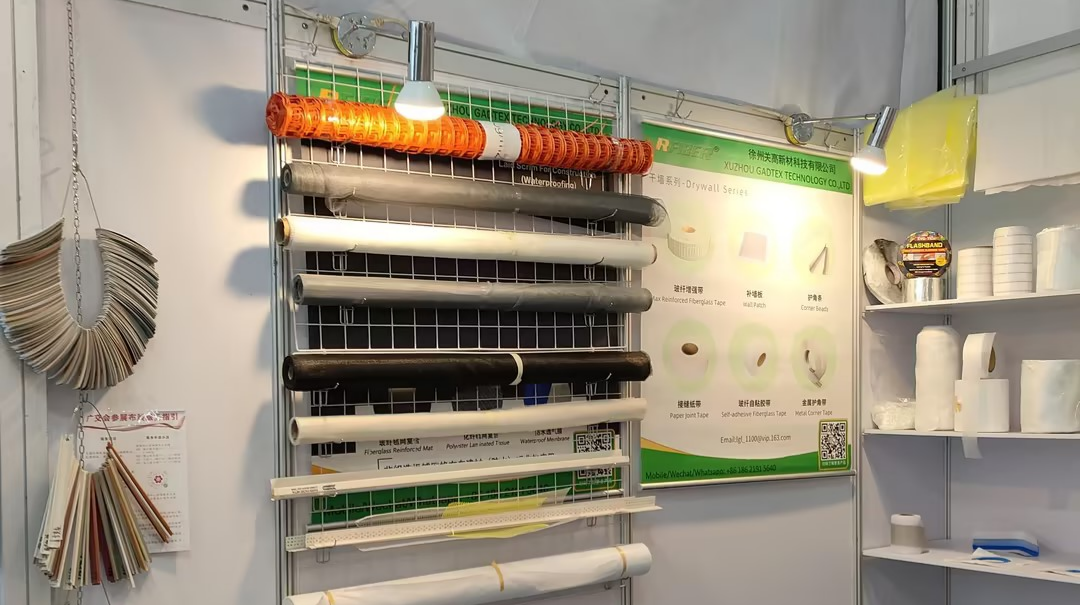
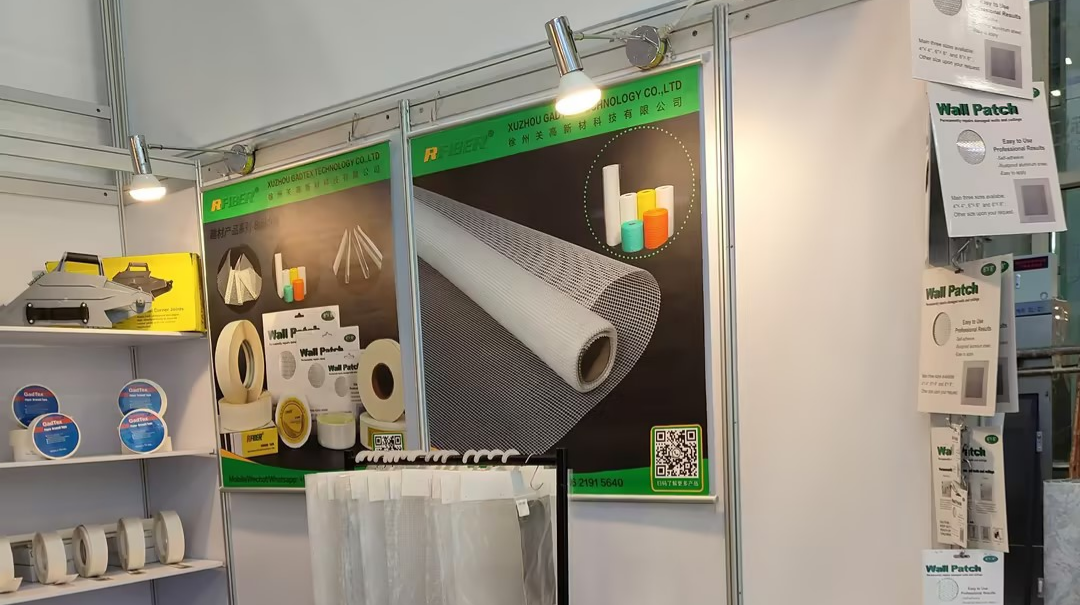
Water intrusion is the single biggest cause of building envelope failures. Waterproofing with fiberglass has become the standard approach because fiberglass mesh does not rot, corrode, or absorb moisture. Waterproofing mesh — whether embedded in a membrane, used as a reinforcement for liquid-applied coatings, or applied as a tape at transitions — provides the mechanical strength that keeps the waterproofing system intact.
Fiberglass Mesh Tape For Waterproofing is used at overlaps, penetrations, and terminations where the membrane is most vulnerable. Shanghai Ruifiber’s tape products use a carrier mesh with controlled elongation and an adhesive system selected for the substrate mix most commonly seen on site: modified bitumen, TPO, EPDM, concrete, primed metal, and gypsum board. The result is a detail tape that grabs immediately and ages without turning into a peel-and-stick failure.
For Roofing Fiberglass Mesh, the company supplies products designed for torch-applied and self-adhered membrane reinforcement. The mesh provides dimensional stability during installation and long-term resistance to thermal cycling and UV degradation. When specifiers search for Fiberglass Mesh In China or Fiberglass Mesh Supplier China, they are increasingly looking for a partner who can provide not just the mesh, but the technical data to support warranty requirements.
Concrete That Doesn’t Crack — Fiberglass Mesh For Concrete and Alkali Resistant Fiberglass Mesh
Concrete is strong in compression but weak in tension. Without reinforcement, every slab, overlay, and repair is vulnerable. Fiberglass Mesh For Concrete — and specifically Alkali Resistant Fiberglass Mesh — has become the standard solution for controlling cracking in thin overlays, stucco, shotcrete, and precast elements.
The key challenge is alkalinity. Fresh concrete has a pH above 12, which attacks unprotected glass fibers. Standard E-glass loses strength rapidly in this environment. True Alkali Resistant Fiberglass Mesh uses AR-glass fibers containing zirconia, which resist alkali attack and maintain tensile integrity for the service life of the structure.
Shanghai Ruifiber manufactures Alkali Resistant Fiberglass Mesh with documented zirconia content (>14% ZrO₂) and a specially formulated coating that further protects the fibers and provides excellent bonding with cementitious matrices. Available in mesh sizes from 5×5 mm to 12.5×12.5 mm and weights from 145 g/m² to 350 g/m², GADTEX AR mesh is used in thin concrete overlays for bridge decks and parking garages, external wall insulation systems (EIFS), tile backing and waterproofing membranes, and stucco and plaster reinforcement.
For Eifs Fiberglass Mesh, the company supplies products that meet the tensile and alkali-resistance requirements of international standards such as ASTM D6637 and EN 15498. When a search query reads Fiberglass Mesh Factory or Fiberglass Mesh Manufacturer, the answer should include documented quality control — not just a price list.
Windows, Screens, and the Unseen — Window Screen Mesh and the Broader World of Engineered Textiles
Not all reinforcement is hidden in concrete or composites. Window screen mesh is a familiar product that most people interact with daily. But the engineering behind it — UV stability, tear resistance, dimensional stability — is the same science that goes into Fiberglass Mesh China products for industrial applications.
Shanghai Ruifiber produces window screen mesh in fiberglass and polyester variants, with mesh counts and wire diameters optimized for insect exclusion, solar shading, and airflow. The same weaving and coating expertise that produces Eifs Fiberglass Mesh and Roofing Fiberglass Mesh is applied to window screens, ensuring consistent quality and long service life.
For distributors searching Fiberglass Mesh Suppliers or Fiberglass Mesh Manufacturers China, the breadth of the product range matters. A supplier who can provide everything from Wall Corner Tape to Marine-Grade Roving to Window Screen Mesh is likely to have the process depth to handle custom requirements. Shanghai Ruifiber’s vertical integration — from yarn sourcing to slitting and packaging — means that every product, regardless of application, is backed by the same quality system.
Why the Search for ‘Fiberglass Mesh Manufacturers China’ Is Really a Search for Accountability
The global search volume for Fiberglass Mesh Factory, Fiberglass Mesh Supplier, Fiberglass Mesh Manufacturer, Fiberglass Mesh Manufacturers China, Fiberglass Mesh Manufacturers, China Fiberglass Mesh, Fiberglass Mesh Suppliers, Fiberglass Mesh Supplier China, and Fiberglass Mesh In China has never been higher. But the intent behind these searches has changed. Buyers are no longer looking for the cheapest quote; they are looking for a partner who can demonstrate:
- Process control: Who owns the coating line? Can they prove AR content?
- Consistency: Will the next 20 containers feel and perform identically to the first?
- Customization: Can they modify mesh geometry, binder chemistry, or roll width to fit my specific application?
- Traceability: Can they provide batch records that satisfy ISO, ASTM, or EN audits?
Shanghai Ruifiber answers all four requirements because it is not a trader aggregating stock from multiple mills. It is a Fiberglass Mesh Factory with integrated production: yarn sourcing, weaving, coating, slitting, and packaging under one management system. This vertical integration allows the company to offer standard and custom mesh sizes from 3×3 mm to 25×25 mm, multiple fiber types (E-glass, AR-glass, C-glass, polyester, and hybrid combinations), specialized coatings (acrylic, SBR, PVOH, and customized formulations), long rolls up to 50,000 meters per roll, and private labeling and OEM services.
Whether a customer searches for Fiberglass Mesh Supplier China looking for a reliable source of AR mesh for EIFS, or a Fiberglass Mesh Manufacturers inquiry for heavy woven roving for boat building, Shanghai Ruifiber responds with technical data, samples, and a production timeline — not a generic catalog.
Conclusion — From ‘Why Use Paper Tape on Drywall’ to ‘Which Factory Should I Trust’
The question why use paper tape on drywall is a good starting point — it teaches us that every reinforcement decision depends on the specific application, environment, and performance requirements. But the construction and composites industries have moved far beyond drywall. Today’s projects demand reinforcement solutions for Fiberglass Mesh For Concrete, Roofing Fiberglass Mesh, Eifs Fiberglass Mesh, Marine-Grade Roving, Boat Cloth, Waterproofing Mesh, Wall Corner Tape, Window Screen Mesh, and dozens of other specialized applications.
Shanghai Ruifiber (GADTEX) invites engineers, specifiers, and procurement professionals to move beyond search queries and into technical conversations. Contact our team for samples, technical data, or a factory visit. Let us show you what happens when the reinforcement is designed, manufactured, and delivered by people who understand that every layer matters — and that the factory behind the product is the most important specification of all.
Address
Head office Add: BLDG#26,MAX Technology Park Phase II,Baoshan District,Shanghai China
Factory Add: Shanghai Ruifiber (Fengxian) Industry Park, Fengxian, Xuzhou, China
info@ruifiber.com
ruifibersales2@ruifiber.com
Phone
Sales: 0086-159-6804-7621
Support: 0086-186-2191-5640
Hours
Monday-Friday: 9am to 6pm
Saturday, Sunday: Closed
WANT TO WORK WITH US?
Post time: Jun-15-2026