
This article walks through what the binder actually does, how each type behaves, and how to choose by process — ending with the five questions worth asking any supplier before you order.
What the Binder Actually Does in a Chopped Strand Mat
Chopped strand mat is a non-woven reinforcement made from E-glass fibers cut to roughly 25–50 mm and distributed in a random pattern. In their dry state, those short fibers are loose and easily disturbed. The binder is the temporary adhesive that gives the mat enough integrity to be cut, carried and positioned in a mold — nothing more.
A good CSM binder must balance four demands:
- Dry strength: To keep the mat intact during handling.
- Fast dissolution: Once resin arrives.
- Compatibility: Does not interfere with the resin system cure.
- Low content: Adds little structural strength, so less is more.
Industry practice usually reports binder content as a weight percentage of the mat — often checked through loss-on-ignition (LOI) testing. On Ruifiber’s CSM page, the specification table prints a “Size Content” column that decreases from 10.5 down to 3.3 across the 100–900 g/m² weight grades. The practical takeaway: heavier mats carry proportionally less binder, and the exact figure is worth confirming rather than assuming.
The Purchasing Trap: Because both binder types are sold under the same product family, a quotation can look identical. The only reliable protection is to name the binder type explicitly in your RFQ.
Emulsion-Bound CSM: Soft, Conformable, Slower Wet-Out
Emulsion-bound mat is produced by impregnating the fiber web with a water-based liquid binder which forms a soft film around the fibers. This gives it a signature soft and pliable feel.
- Conformability: Drapes over deep draws and tight radii without “bridging” (tenting).
- Handling: Clean cut edges and less fiber fuzz during positioning.
- Wet-out behavior: The emulsion film takes longer to break down, buying extra positioning time.
- Clarity: Some residue may remain; test for optical clarity in translucent panels.
Ideal for: Sanitary ware (bathtubs), marine hulls, and complex custom hand lay-up parts.
Powder-Bound CSM: Stiff, Fast Wet-Out, High Clarity
Powder-bound mat uses a fine thermosetting polyester powder fused at fiber intersections. It acts more like “spot welds,” leaving most glass surfaces bare and accessible to resin.
- Faster wet-out: Breaks down quickly on contact with polyester matrix.
- High clarity: Dissolves completely with little residue; preferred for skylight panels.
- Water resistance: Leaves no hydrophilic film; better for tanks and pipes.
- Stiff sheet: Dimensionally stable for automated lines, but may spring back on deep curves.
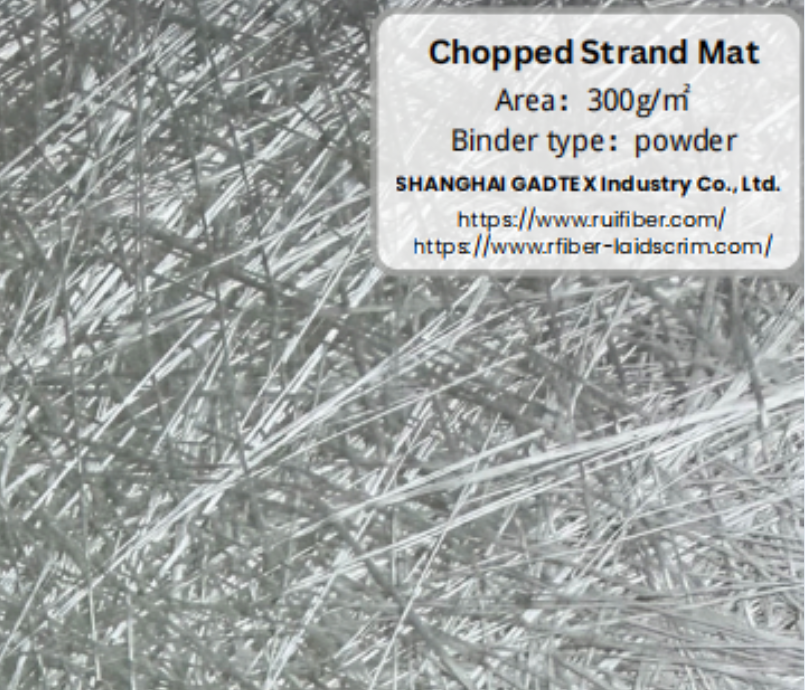
Side-by-Side: What Changes and What Does Not
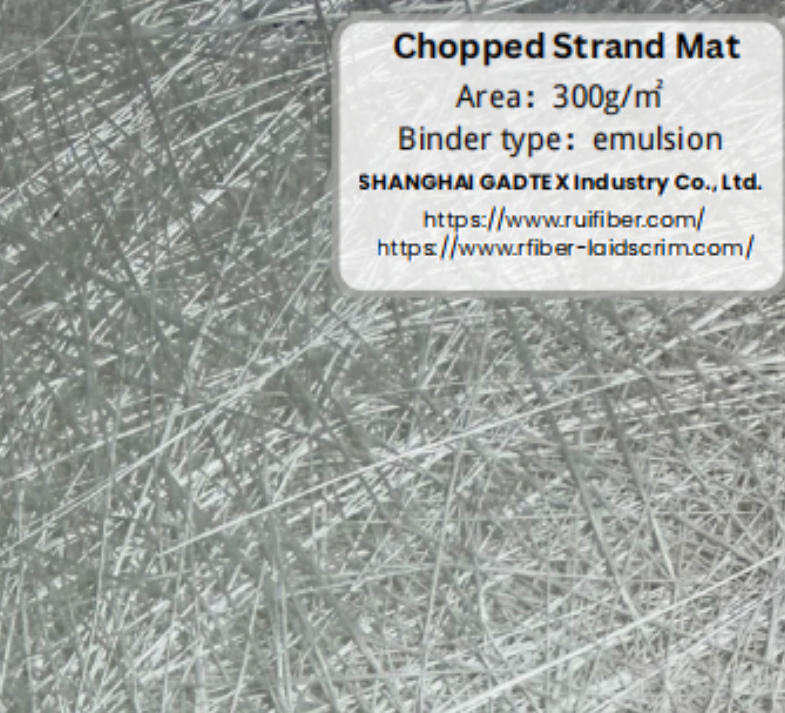
Brand product photo: emulsion-bound CSM at 300 g/m2
| Property | Emulsion-bound CSM | Powder-bound CSM |
|---|---|---|
| Dry feel / drape | Soft, highly conformable | Stiffer, flatter, springs back |
| Wet-out speed | Somewhat slower | Noticeably faster |
| Typical processes | Hand lay-up, Spray-up, RTM | Lamination, Pultrusion, Winding |
Choosing by Process: A Decision Table
| Process | Lean towards | Why | Watch out for |
|---|---|---|---|
| Hand lay-up (curves) | Emulsion | Drape without bridging | Slower wet-out |
| RTM / Infusion | Powder | Uniform wet-out through stack | Permeability behavior |
| Pultrusion | Powder | Flat sheet, fast line speed | Stiffness is an asset |
Five Things to Confirm Before You Order
| # | Confirm | Suggested Question |
|---|---|---|
| 1 | Binder Type & Content | “Is this mat emulsion-bound or powder-bound, and what is the LOI?” |
| 2 | Wet-out Time | “What wet-out time do you measure at what temperature?” |
FAQ
Can I use emulsion-bound mat with epoxy resin?
Possibly, but do not assume it. Epoxy contains no styrene, so wet-out is slower. Run a small test first.
Which binder type is stronger after curing?
Strength is usually similar, though some claim powder-bound is slightly superior due to fused structure. Test coupons for critical parts.
Ready to compare grades?
Browse Ruifiber’s chopped strand mat range — 100–900 g/m², widths to 3300 mm.
Post time: Nov-09-2026