
Is Your Adhesive Tape’s Hidden Reinforcement the Reason for Field Failures — and Why More Tape Engineers Are Switching to Custom-Engineered Polyester Laid Scrim?
In the world of pressure-sensitive tapes, the adhesive gets the glory. Marketing campaigns highlight tack, peel adhesion, and shear holding power. But ask any tape engineer who has dealt with a costly delamination complaint, a roll that snapped during high-speed dispensing, or a splicing tape that crept open under summer warehouse heat — and they will tell you the same thing: the carrier, often invisible and taken for granted, is where the tape either earns its reliability or betrays it.
Whether we are discussing Double Sided Tape used in automotive trim bonding, Foam Tape for window glazing, Duct Tape for HVAC sealing, or Filament Tape for heavy-duty bundling, the common denominator is a reinforcement layer — most frequently a Polyester Laid Scrim — that determines whether the tape stretches, tears, or holds dimensionally stable under load. And as global tape consumption shifts toward thinner gauges, higher throughput speeds, and stricter end-of-life recyclability criteria, the conversation between tape converters and their Scrim suppliers has fundamentally changed. It is no longer about "can you supply 10,000 meters?" It is about "can you engineer a scrim that matches my adhesive chemistry, my coating window, and my customer's field conditions — and prove it batch after batch?"
The Carrier That Makes or Breaks the Bond: Why Scrim Selection Is No Longer an Afterthought in Tape Engineering
But the margin between "good enough" and "field-proven" lies in the details that only a manufacturer who controls the entire scrim production chain can guarantee:
Yarn tenacity and tex uniformity: Does every meter of the 1000dtex or 1670dtex polyester yarn carry the same breaking load, or do weak spots create latent failure zones inside the jumbo roll?
Node-bond integrity: In a Double Sided Tape Carrier, the scrim's junction points must survive the coating process, the slitting process, and the end-user's peel/shear cycle without separating. A scrim that "opens" at the nodes is a tape that fails at the interface.
Open-area ratio and adhesive strike-through: Too dense a mesh starves the adhesive bond; too open a mesh sacrifices tear resistance. The right balance is application-specific — and it requires a supplier willing to dial in mesh geometry, not just pull standard stock off a shelf.
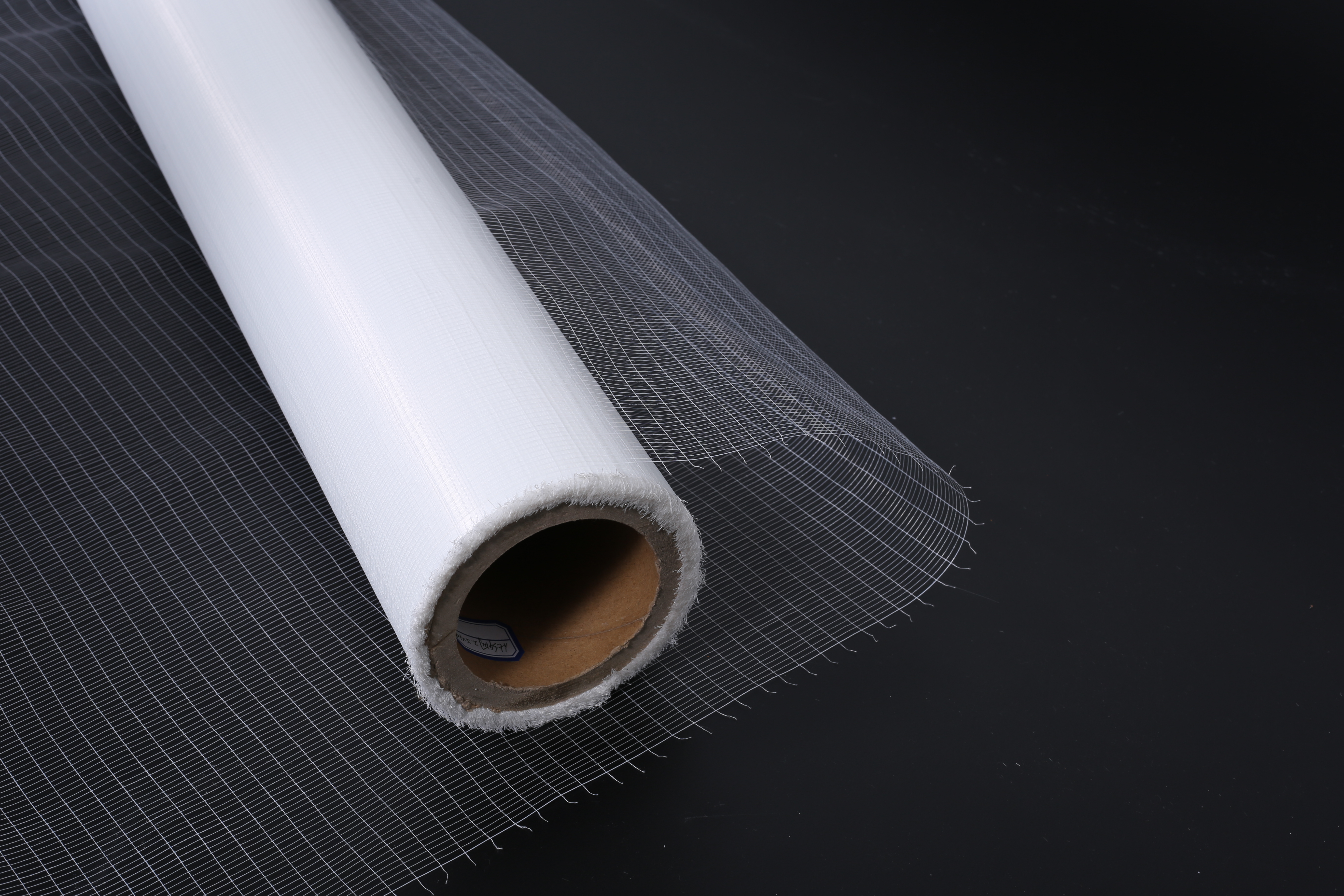
Shanghai Ruifiber (operating globally under the Gadtex / RFIBER brand) has built its tape-industry reputation not on selling commodity scrim, but on engineering the scrim-adhesive interface as a system. Our Polyester Laid Scrim product family — spanning mesh sizes from 2.5×5mm to 12.5×12.5mm, weights from 2 g/m² to 18 g/m², and customizable finishes for silicone, acrylic, rubber-based, and hot-melt adhesive systems — is designed to integrate into the converter's process, not complicate it.
Every pressure-sensitive tape is a composite: adhesive + carrier + release system. In tapes that require structural handling strength — the kind that must not elongate during application, must resist edge-tearing during die-cutting, and must hold dimensional registration when slit to narrow widths — the carrier is not a passive substrate; it is an active mechanical member. Polyester Laid Scrim, with its open-mesh architecture and chemically bonded junctions, has emerged as the preferred reinforcement architecture precisely because it decouples strength from thickness. A 6 g/m² scrim can deliver more tensile stability than a 30-micron solid film, while adding negligible caliper and leaving the adhesive free to flow and wet out the substrate.
Beyond Standard Mesh: How Customized Scrim Architecture Solves Three Chronic Tape Problems
The tape industry's evolution — toward thinner products, higher line speeds, and more demanding end-use environments — has exposed the limitations of one-size-fits-all scrim designs. Three chronic problems consistently drive converters to seek customized solutions:
Problem 1: Flagging and Edge Curl in Die-Cut Tapes. When a Double Sided Tissue Tape or Transfer Tape is die-cut into small pads or gaskets, the exposed scrim edge can act as a wicking path for moisture or a stress-riser for delamination. Solution: a finer mesh scrim (e.g., 5×5mm or 3.3×3.3mm) with denser node distribution and a matched binder system that seals the edge without stiffening the whole composite.
Problem 2: Telescoping and Wandering in High-Speed Slitting. Converters running 500 m/min slitting lines know that a scrim with inconsistent tension profile or variable width will telescope on the rewound log, creating scrap and downtime. Solution: a Polyester Laid Scrim manufactured with closed-loop width control (±1mm tolerance) and uniform yarn tension across the full web width — capabilities that require factory-level process ownership.
Problem 3: Adhesive Bleed-Through in Thin-Bond-Line Applications. In optical bonding, graphic mounting, and medical device assembly, the adhesive bond line must be microscopically thin and void-free. A standard scrim with high loft or uneven node height creates surface irregularities that show through the adhesive. Solution: a calendered or pressed scrim with controlled thickness profile, paired with an open-area ratio optimized for the specific adhesive viscosity.
Shanghai Ruifiber's engineering approach treats each of these problems not as a "material substitution" exercise but as a process parameter optimization — adjusting yarn spacing, binder application method, oven dwell time, and calendering pressure to produce a scrim that behaves predictably inside the converter's specific coating and converting environment.
The Supply Chain Logic Shift: Why Tape Converters Are Moving from "Scrim Trader" Relationships to "Factory Partnership" Models
This is why a growing number of tape engineers and procurement managers are actively searching for terms like Fiberglass Mesh Supplier, Fiberglass Mesh Manufacturer, Fiberglass Mesh Suppliers, and Fiberglass Mesh In China — not to buy commodity mesh, but to identify factory-direct partners who can demonstrate process control, material traceability, and the willingness to customize.
Shanghai Ruifiber fits this description precisely. As a Fiberglass Mesh Factory and Polyester Scrim Manufacturer with integrated production bases in Xuzhou and global sales operations in Shanghai, we offer tape converters something that traders cannot: direct access to the people who control the yarn, the binder chemistry, the loom settings, and the quality metrics. When a converter asks, "Can you make a 4×4 ends-per-inch scrim with a 1100dtex yarn and a water-based acrylic-compatible binder, delivered in 52-inch rolls with a maximum 2% elongation at break?" — we don't forward the question to a mill. We answer it from our own process data.
What the Next Generation of Tape Scrim Looks Like: Lighter, Cleaner, More Recyclable
The global adhesive tape market, valued at over $65 billion annually, consumes vast quantities of reinforcement scrim. Historically, much of this volume flowed through trading intermediaries who aggregated standard mesh sizes from multiple mills. The model worked — until it didn't. As tape converters face pressure to reduce material waste, certify supply chain transparency, and respond faster to regional specification changes, the intermediary model introduces unacceptable friction:
Batch inconsistency: When a trader sources from three different factories to fill a container, the converter receives scrim rolls that may differ in hand-feel, binder reactivity, or width stability — invisible differences that cause visible defects in the finished tape.
Limited customization bandwidth: A trader can sell what the mill produces; only a factory can modify what the mill produces.
Traceability gaps: End users in automotive, aerospace, and electronics now demand full material genealogy. A trader's certificate of analysis is only as good as the information the factory shares — and if the trader doesn't own the data, the converter owns the risk.
The regulatory and market pressure on single-use plastics and non-recyclable composites is reshaping the tape industry's material choices. Polyester Laid Scrim, already favored for its strength-to-weight ratio, is now being evaluated for its end-of-life profile. Can the scrim be separated from the adhesive? Can the polyester be mechanically recycled? Can the binder system be reformulated for compostability?
Shanghai Ruifiber is actively developing scrim variants that address these questions:
Reduced-binder scrims: Using optimized node-bonding chemistry that achieves equivalent strength with lower binder add-on, reducing the non-fiber content of the composite.
Monocomponent scrims: Designed for compatibility with mono-material tape constructions (e.g., all-polyester systems) that simplify recycling streams.
Narrow-width precision slitting: Delivering scrim rolls that are ready-to-run on tape coating lines without secondary slitting, reducing edge waste and handling damage.
These developments are not theoretical. They are being qualified with tape converters in Europe, North America, and Southeast Asia who recognize that the next competitive advantage in tape manufacturing will come not from cheaper raw materials, but from smarter material systems — and that starts with the scrim.
Conclusion — The Tape's True Test Happens After It Leaves Your Factory. Make Sure the Scrim Passes First.
Every roll of tape shipped is a promise: that it will perform as specified, under real-world conditions, for the duration of its intended service life. That promise depends on thousands of meters of reinforcement that nobody sees — until something goes wrong. By choosing a Polyester Laid Scrim partner that controls the yarn, the binder, the geometry, and the quality metrics from raw material to finished roll, tape converters eliminate the most common variable in field failures: the unknown carrier.
Shanghai Ruifiber (Gadtex / RFIBER) is ready to support your next tape development program — whether you need a standard scrim for high-volume production or a customized architecture for a specific adhesive system. Contact our engineering and sales team to discuss your requirements, request samples, or schedule a factory visit.
Contact us for scrim samples, technical data, or a consultation on your tape reinforcement needs:
Email: info@ruifiber.com | Tel: 0086-18621915640
Post time: Jun-10-2026