
Fiberglass Mesh for Marble and Stone Backing: Heavy-Weight Selection
A crate comes back from the port with one slab cracked along a vein. The backing was there — white, regular, glued across the whole back. So the workshop asks the obvious question: was the mesh heavy enough? Nobody asks whether the adhesive ever reached the yarn in the middle of the sheet.
Backing performance is not set by one number. It is set by three: how much glass sits in a square metre, how that glass is arranged, and what carries stress from the stone into the glass. Suppliers quote the first, rarely the second, almost never the third — which is why a workshop can buy "backing mesh" three times and get three different results.
The market has a shortcut for this: a single figure, repeated whenever stone backing comes up. This article takes that figure apart, reads the published table properly, and ends with the fields to put in a request. The EIFS side of the same family is covered separately in this series.
Backing a mosaic sheet and backing a slab are not the same job
The phrase "marble backing" covers two products with different jobs, and most conversations about it mix them.
A mosaic sheet is a small assembly: stone pieces held in alignment by a carrier so they can be boxed, shipped and pressed into mortar as one unit. Its backing is a handling aid with a short service life. It has to stay attached through packing and setting, stay flat, and not block the bedding. Once the sheet is in the mortar, the substrate does the structural work.
A slab is a plate. Its backing has to survive being cut on a bridge saw, profiled, polished, crated, lifted and trucked. The events are mechanical and repeated, and the failure to prevent is a fissure opening into a break — during a lift, in a container, or on the saw table when a cut crosses a weak zone.
Light mesh can be entirely adequate for the first and marginal for the second, not because the mesh changed but because the job did. Stone-trade writing adds a second split: backing applied at the quarry has to survive months of storage and repeated handling, while shop-applied backing only has to survive one cutting and delivery sequence.
What a backing can and cannot do to the stone
Stress does not travel from stone to glass directly. It goes stone, adhesive, yarn, adhesive, and back into stone on the far side of the fissure. Every interface has to work. A void under the mesh, a dry spot where resin never wet the yarn, a coating the adhesive does not bond to — any one of them breaks the chain, and past that point the mesh is decoration with a good tensile figure on its datasheet.
So a backing is a second line of defence. It limits how far a crack that already exists can run. It does not make the stone stronger, and it does not turn a marginal slab into a structural one.
Stone-industry writing is blunt about the standards side, and the bluntness is useful. Flexural strength of dimension stone is measured by a test method — ASTM C880 is the one usually cited — on prepared specimens under a controlled bending load. The result describes the stone, not a stone-plus-mesh-plus-adhesive assembly. The same writing notes that ASTM C503 is the marble specification, that ASTM C1526 covers serpentine rather than marble, and, most usefully for a buyer, that a report should state whether the specimens included the backing.
No published standard grades the mesh-to-stone bond. Where the bond is what the application depends on, the evidence has to come from a trial on your adhesive and your stone.
One figure, three specs: what g/m² hides
The published page for this mesh family gives three columns that carry information: mesh count per 25 mm, finished weight in g/m², and tensile strength per 20 cm of width.
Finished weight is the number buyers compare, and the one that says least alone. The same weight can be built from many thin yarns in a tight grid or few thick yarns in an open one, and the table contains both cases. They can be separated with one calculation: yarn length per square metre is one over the weft pitch plus one over the warp pitch, where pitch is 25 mm divided by the count; glass mass is the finished weight less the stated minimum of 18% resin; divide one by the other for the linear density of a single yarn.
| Item (as published) | Count per 25 mm | Pitch, mm | Yarn length per m², m | Finished weight, g/m² | Glass mass at 18% resin, g/m² | Derived yarn, g/m |
|---|---|---|---|---|---|---|
| A2.5*2.5-110 | 2.5 / 2.5 | 10.0 | 200 | 110 | 90.2 | 0.45 |
| A2.5*2.5-125 | 2.5 / 2.5 | 10.0 | 200 | 125 | 102.5 | 0.51 |
| A5*5-75 | 5 / 5 | 5.0 | 400 | 75 | 61.5 | 0.15 |
| A5*5-125 | 5 / 5 | 5.0 | 400 | 125 | 102.5 | 0.26 |
| A5*5-145 | 5 / 5 | 5.0 | 400 | 145 | 118.9 | 0.30 |
| A5*5-160 (4/4) | 4 / 4 | 6.25 | 320 | 160 | 131.2 | 0.41 |
| A5*5-160 (5/5) | 5 / 5 | 5.0 | 400 | 160 | 131.2 | 0.33 |
Three assumptions set the error bar: resin taken at the published minimum, so higher resin lowers the glass mass; yarns treated as straight, whereas leno weaving crosses them and adds length; coating distribution ignored. The figures are upper bounds, but the comparison between rows holds, because the same bias applies to every row.
The heavier product uses the finer yarn. The 160 g/m² fine-grid row works out near 0.33 g/m; the 110 g/m² coarse-grid row near 0.45 g/m. Buying more grams can mean buying more, thinner strands rather than a heavier one.
Grid density changes by a factor of four. A count of 2.5 per 25 mm is a 10 mm pitch, a count of 5 is a 5 mm pitch — roughly ten thousand intersections per square metre against forty thousand, from a similar total of glass.
The same weight is two products. Two rows are listed at 160 g/m², one at 4/4 and one at 5/5, with different tensile values: 1550 and 1650 N/20 cm on one, 1450 and 1600 on the other. "160 gram mesh" does not say which you are buying.
Which of the three matters most depends on what is being prevented. A fine fissure in a thin slab is bridged by many yarns close together, each carrying a small share. A point load from a clamp or a corner impact is resisted by yarn cross-section at the contact. Wet-out and bond depend on surface: how much yarn the adhesive can reach. Weight feeds all three and decides none.
The 300 g/m² figure: what it is and what to check
It appears in EIFS articles as a closing sentence, after the usual render-reinforcement bands: stone veneer and marble backing need 300 g/m² or more to take point loads. In the material reviewed for this piece, no version came with a source, a test method, a stone thickness, or a distinction between sheet and slab. It is stated as background, not as a finding.
The same material contains the opposite picture. A supplier whose line is dedicated to stone backing publishes its grades in the low band and calls the lighter ones suitable for thin stone and smooth finishes. An adhesive manufacturer's stone guide specifies lightweight, alkali-resistant mesh for epoxy lamination. A third supplier advertises a wide range while its own model table sits well inside the low band. These are supplier positions, not standards — but they show that 300 g/m² is not a universal entry requirement.
The fair reading is that the sentence is shorthand for "do not back a slab with plaster mesh". That warning is real, and aimed at the contractor with a roll of render mesh on the shelf and a broken slab on the floor. As shorthand it works. As a specification it does not, because it answers a question the buyer did not ask.
Heavy grades are real and have a place: thicker stone, higher point loads, a thick adhesive layer that needs mechanical keying through a larger opening, a repaired zone that must be spanned rather than followed. The reason this article recommends no number is that the number depends on slab, adhesive and handling sequence — three things a mesh datasheet cannot see.
| What you hear | What it usually stands in for | How to check it |
|---|---|---|
| "Backing needs 300 g/m² or more" | "More glass than render mesh" | Ask which thickness and which handling event the figure came from |
| "It is alkali resistant, so it is fine outdoors" | "It is coated" | Ask which system it goes into: cured epoxy is not alkaline, cementitious bedding is |
| "Heavier mesh makes the slab stronger" | "Heavier resists more" | Ask for stone data and assembly data separately; stone strength is unchanged |
| "5 by 5 is the standard for stone" | "A common grid" | Ask for count per 25 mm and yarn size, then match to the defect scale |
| "The tensile figure is the backing strength" | "One yarn property" | Ask the gauge width, and what the bond to your adhesive measures |
Four questions settle most of it. Sheet or slab? What data sits behind the figure, even if the answer is only "our experience"? Does the supplier's own model table list that grade, or only the brochure headline? And is the number a finished weight including coating, or a glass weight?
Bond first: two systems, two failure modes
If the mesh only works through the adhesive, the adhesive decision comes before the mesh decision, and it splits the problem in two.
In epoxy lamination, the mesh is laid into a thin layer of two-part epoxy on a clean slab back, pressed down and worked until the air is out. The dominant failures are voids, dry patches and lifted spots. Alkali resistance is not the first question, because cured epoxy is not an alkaline environment; surface preparation, resin viscosity, air removal, seam overlap and full cure before cutting are. Published practice is a sequence — clean and abrade, mix and use within working time, spread evenly, lay the mesh, press out air, cure undisturbed, trim and inspect — and the sequence matters more than the brand. One detail survives without the numbers: a single thick pour concentrates shrinkage stress, and two thinner passes are the usual way around it.
In cementitious backing, the mesh is pressed into a wet slurry or mortar bed. The environment is alkaline by design, the glass is under chemical attack for the life of the assembly, and shrinkage of the bedding is a moving part. Alkali resistance and coating integrity move to the front.
| Epoxy lamination | Cementitious backing | |
|---|---|---|
| Where it is done | Plant or workshop, on a clean slab back | Quarry or workshop, into a wet bed |
| What carries stress | Cured epoxy bridging stone and yarn | Hydrated binder keying the mesh |
| Governing property | Wet-out and a void-free bond | Alkali resistance and coating integrity |
| Dominant failure | Delamination, dry spots, shrinkage in thick layers | Alkali degradation of glass, shrinkage cracking |
| Evidence to request | Bond trial on your adhesive, plus resin system | Alkali test method and coating specification |
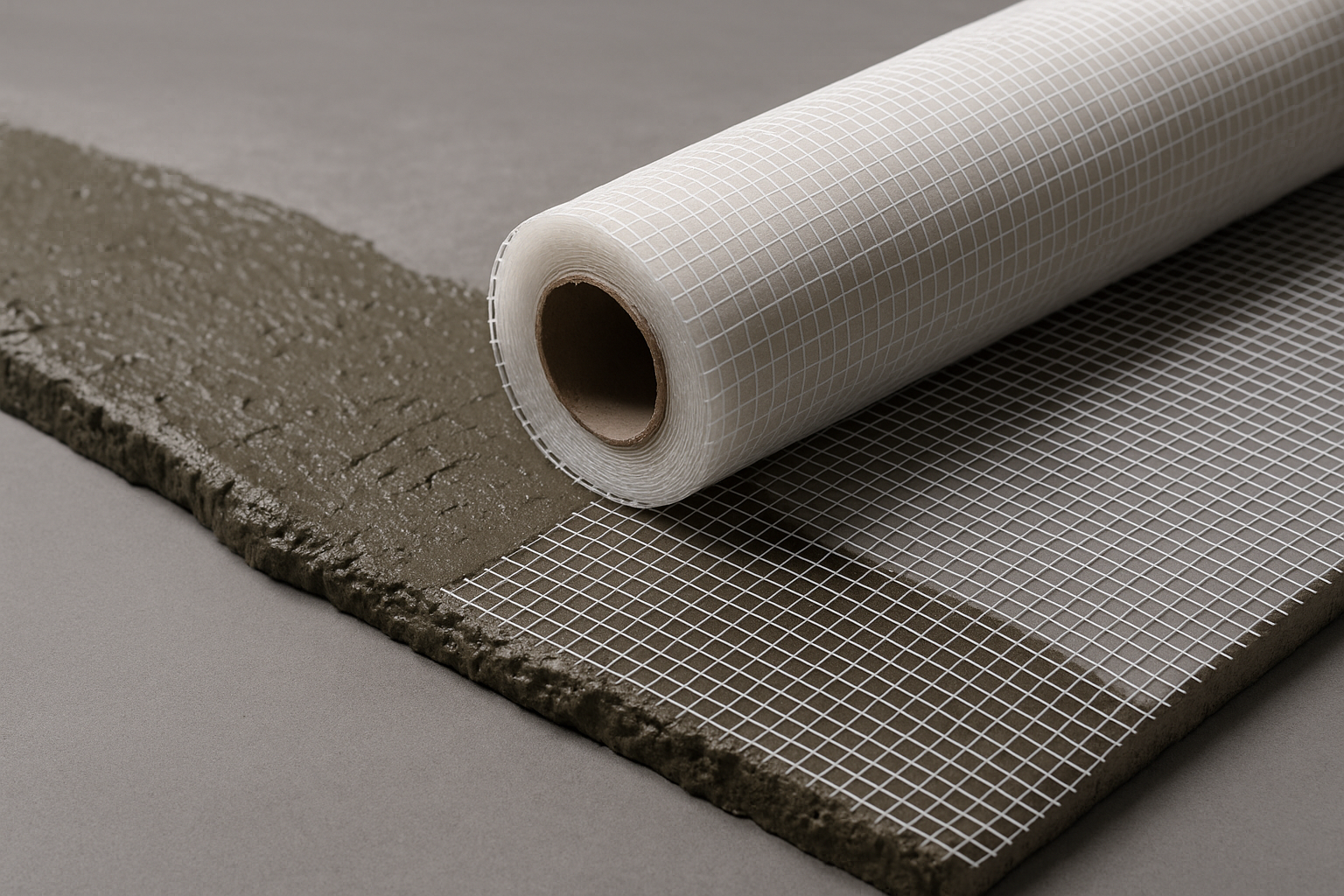
The published page states the coating as an acrylic acid copolymer and lists the product as non-adhesive, so the bond is something you add. It does not state compatibility with epoxy systems, and the coating name should not be read as proof of it: adhesion depends on sizing and coating chemistry as much as on polymer family. Ask for evidence, then run a bond trial.
A trial does not need a laboratory. Take an offcut of the actual stone, apply the mesh with the actual adhesive and procedure, cure as production would, then lift a corner and cut a strip across the mesh to see where failure occurs. If the mesh peels away with adhesive still on the stone, the interface is the weak link. If the mesh tears and the adhesive holds, the yarn is the limit. Keep the sample and the date.
One more split before the request goes out: are you bonding, or receiving factory-backed material? Shop-applied backing only has to survive your own sequence; factory backing has to survive storage and repeated handling first. Different effort, different questions.
Reading the published table line by line
The eight rows reward a close read, because what is missing is as informative as what is in them.
Two counts are offered — 2.5 per 25 mm, a 10 mm pitch, and 5 per 25 mm, a 5 mm pitch — with weights from 75 to 160 g/m². Tensile is tabulated per 20 cm of width, warp and weft separately, and the directions are not equal: the 110 g/m² coarse row lists 1200 and 1000, the 160 g/m² fine row 1450 and 1600. On a slab the load path does not align itself with the warp, so check capacity on the weaker direction.
The unit deserves its own line. Every figure on the page is per 20 cm; a supplier quoting per 50 mm is using a different gauge. The same material measured over 50 mm gives roughly a quarter of the number, because the width is a quarter. That is a width conversion, not a standard conversion and not a performance equivalence — it only stops two datasheets from being compared as if they spoke the same language.
Then the two numbers that do not agree. The header states a range of 500–2400 mm width and 30–600 g/m² weight, and describes the family as soft, standard and hard variants. The table below stops at 160 g/m² and does not define the three variants. Both statements sit on the same page: the header says what the family can cover, the table lists the models you can order against. For a buyer, only the second turns into a quotation. A declared range is not a product list, and the gap between them is where surprises live.
The table also omits roll length, moisture content, adhesion data, the definition behind soft, standard and hard, and any row above 160 g/m². Four can be answered in one email.
What to put in the backing RFQ
Seven fields, ordered by how much trouble their absence causes.
1.Scenario. Sheet or slab; stone type, thickness, finish; whether the piece is cut after backing.
2.Who bonds. Factory-backed or shop-applied. If shop-applied, the adhesive and the trial are yours.
3.Bond system. Epoxy or cementitious — this decides which of the next three fields is critical.
4.Three numbers together. Finished weight, count per 25 mm, yarn size; or count and weight, from which yarn size follows.
5.Coating and compatibility. Coating type, plus whatever evidence exists for adhesion to your adhesive.
6.Roll geometry and variant. Width and roll length, which set how many seams the job needs, and which variant is quoted.
7.Test reports. Gauge width for the tensile, method behind the alkali claim, and whether anything was tested as a bonded assembly.
A quotation that answers all seven can be compared with another; one that answers only the first and the fourth cannot.
FAQ
What weight of fiberglass mesh should I use for marble backing?
No single figure survives contact with the variables. Start from the slab — thickness, fissure pattern, whether it will be cut, how it will be lifted — then pick a mesh whose weight, grid and yarn size suit that job, and confirm the bond on your own adhesive. This family's published range runs from 30 to 600 g/m², but the table lists 75 to 160 g/m², so ask for the model list rather than the range.
5 by 5 or 2.5 by 2.5?
Different tools. A 5 per 25 mm count gives a 5 mm pitch and four times the intersections of a 2.5 count at 10 mm. The fine grid puts more yarns across a small fissure; the open grid leaves room for adhesive to key through. Match the grid to the defect you are holding together.
Does a backing mesh make a thin slab stronger?
Not in the sense of raising the stone's flexural strength. It can keep a cracked piece together and slow a fissure, which changes the consequence of damage rather than the strength of the material. If a report is used to support a claim, check whether the specimens included the backing.
Epoxy or cementitious?
Follow the process you run. Epoxy puts the emphasis on wet-out, air removal and cure; cementitious puts it on alkali resistance and coating integrity.
Can the same mesh serve EIFS and stone?
The family covers both, and the page lists EIFS, roofing, stone reinforcement and EPS mesh among its applications. The criteria do not transfer: render reinforcement is judged against a base coat, stone backing against a slab, a saw and a container.
The backing decision is three decisions
A backing that fails is rarely a backing that was too light. More often the adhesive never reached the yarn, or the grid was chosen for the wrong defect, or the weight was picked from a sentence with no source behind it.
So make three decisions instead of one. Decide which job you are doing — sheet or slab, shop-applied or factory-backed. Decide the three numbers together: weight, count, yarn size. Then decide the bond system, and get evidence for it from your own stone and adhesive. The number everyone quotes stays useful, but as a warning about plaster mesh, not as a specification.
The family described here is listed with the rest of the reinforcement products on the Ruifiber products page; the table, application list and coating description quoted above are on the fiberglass mesh for marble page.
Address
BLDG#26,MAX Technology Park Phase II,Baoshan District,Shanghai China
Phone
0086-21-56976143
0086-18621915640
021-56655615(Domestic)
13061721501
Hours
24-hour service
Shanghai Ruifiber Industry Co., Ltd.
Sales Office Address
Shanghai Ruifiber (Fengxian) Industry Park, Fengxian, Xuzhou, China
Tel:+86-21-56976143 021-56655615(Domestic) +86-18621915640 13061721501
Fax: +86-21-5697 5453
Web site: www.rfiber-laidscrim.com
Online Shops: https://ruifiber.en.alibaba.com (International) https://ruifiber.1688.com(China)
Shanghai Ruifiber (Fengxian) Industry Park

Shanghai Ruifiber (Fengxian) Industry Park
Address: Fengxian Electric vehicle Industrial Park accessories Park, Xuzhou, Jiangsu, China
Want to work with us?
Post time: Nov-03-2026